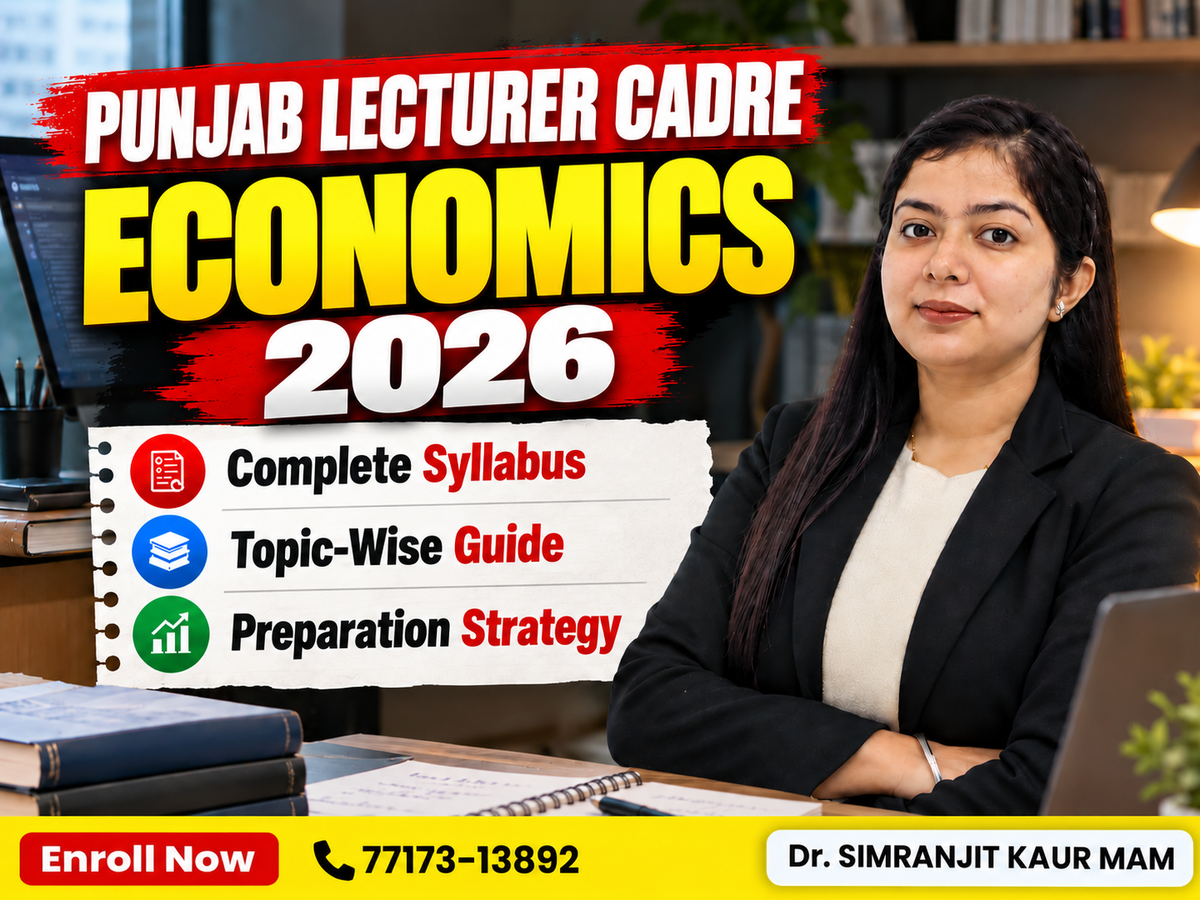

Becoming a lecturer in a Punjab government school is a clear goal for many Economics postgraduates. The exam is run by the Education Recruitment Directorate, Punjab, and only a small number of Economics posts are on offer. A student who knows the syllabus well and practises in the right order has a real advantage over one who studies at random.
In this guide, MS Study Guru breaks the Punjab Lecturer Cadre Economics syllabus into six clear topics, explains what you actually need to study in each one, and shares a practical plan built on the teaching approach of Dr. Simranjit Kaur, who secured JRF in Economics with a 99.93 percentile. Read it once, bookmark it, and use it as your roadmap.
Why Punjab Lecturer Economics Needs Its Own Plan
This exam tests Economics at postgraduate depth, but it is not the same paper as UGC NET. Reports on the syllabus include Punjab-specific topics such as the Punjab economy, rural finance and economic planning in Punjab, which general economics books rarely cover. A student who prepares only from NET material can lose easy marks there.
The exam is also objective, so one weak unit can pull the whole score down. That is why this exam rewards steady coverage of every unit more than deep work on a single favourite topic.
Punjab Lecturer Cadre Economics 2026: Latest Status
Latest status: Economics was first scheduled for 5 September 2026, but the Punjab Lecturer exam was postponed. A revised schedule was released for other subjects. As of 12 October 2026, we could not confirm a new Economics date. Check erd.punjab.gov.in for the latest notice.
Before you plan your months, check that you can apply and know what the paper looks like.
- Posts: The recruitment covers 1,013 posts across 12 subjects. Economics is reported to have 35 regular and 15 backlog vacancies.
- Qualification: Reports say a Master’s in the subject with 55% marks, a B.Ed., and Punjabi at matriculation level. One site lists NET or SET instead, so read the eligibility clause in the official notice.
- Age: Reported as 18 to 37 years for the general category, with relaxation for reserved categories.
- Selection: A written test followed by document scrutiny, with no interview, according to one report.
- Pattern: Most reports describe one objective OMR paper of 150 questions, 150 marks and 150 minutes, with no negative marking. Some sources mention a general section (Punjabi, English, teaching aptitude, maths and GK) next to the subject section, and one reports 300 questions in total. Confirm this on your admit card and the official notice.
Punjab Lecturer Cadre Economics Syllabus
Prep sites summarise the Economics syllabus in six areas. Here is the list before we go through each one in detail. The official ERD Punjab syllabus PDF is the final authority, so tick off every topic against it.
- Microeconomics
- Macroeconomics, including monetary policy
- International economics
- Development economics
- Statistics in economics
- Punjab economy, rural finance and economic planning in Punjab
We could not verify any official topic weightage, so ignore claims like “this unit carries 30%.” Prepare every unit, and spend extra time where your mock-test scores are weakest.
Topic-Wise Guide to Punjab Lecturer Economics
1. Microeconomics
Start here, because the logic of demand, supply and prices feeds almost every other unit. Prep sites list consumer and producer theory, market structures and welfare economics. Revise utility and demand first, then production and costs, then compare perfect competition, monopoly and the other market forms on price, output and efficiency. Draw every diagram yourself until you can do it without looking at your notes. MCQs often ask what happens when one factor changes, so know why each curve shifts.
2. Macroeconomics and Monetary Policy
This is a wide unit, so give it proper time. Reported topics include national income accounting, classical and Keynesian economics, consumption and investment functions, IS-LM, fiscal and monetary policy, inflation, business cycles and open-economy basics. Learn the formulas and the direction of each effect, and keep a one-page summary of how monetary and fiscal tools work.
3. International Economics
Prep sites list trade theories, balance of payments, foreign exchange and the roles of the WTO, IMF and World Bank. Make a one-page comparison of the main trade theories, and learn how the balance of payments is structured. Questions here are usually direct, so clear definitions earn quick marks.
4. Development Economics
Expect growth and development measurement, development models such as Lewis, Rosenstein-Rodan and Nurkse, human development and poverty programmes. Write short notes on each model with its main idea and its limits, and learn how development is measured. This unit connects well with the Punjab economy topics, so study the two close together.
5. Statistics in Economics
This unit is short, but it gives quick marks once you know the methods. Practise numerical problems often, in small daily sets. Keep a sheet of formulas and a few solved examples for revision before tests. Check the official PDF for the exact statistical topics.
6. Punjab Economy, Rural Finance and Planning
This is the unit that separates a Punjab-focused plan from a general NET plan. Prep sites list the Punjab economy, rural finance and economic planning in Punjab. General economics books rarely cover these topics, so make your own notes from government sources, such as the Economic Survey of Punjab where available. Study this unit in a fixed weekly block so it does not get left to the last week.
How to Prepare Economics for Punjab Lecturer Cadre
Follow this simple order so your preparation stays organised and steady.
- Download the official syllabus from ERD Punjab and turn each topic into a checkbox.
- Begin with microeconomics and macroeconomics, because the later units depend on them.
- Keep one notebook only for diagrams and formulas. A correct diagram often saves a whole question.
- Solve 20 to 30 MCQs right after finishing each unit, and keep a log of wrong answers with the reason for each mistake.
- Give the Punjab economy its own fixed weekly slot, using government sources.
- In the last 2 to 3 weeks, take timed full tests of 150 questions in 150 minutes, and review each test within 24 hours.
Because the Economics exam date is not confirmed, plan by the time you have. With about 4 weeks, cover core micro and macro, then the Punjab economy, and take a full test every 3 to 4 days. With about 8 weeks, finish all units in the first 5 weeks, revise in weeks 6 and 7, and use week 8 for full tests. With 12 weeks or more, add a second round of notes revision and a weekly full test from week 6.
We could not verify a public, official archive of past Punjab Lecturer Economics papers. Until you find one on the ERD Punjab website, practise with MCQs on the same topics from SET or UGC NET Economics papers and unit-wise mock tests. Use them to learn the question style, not to guess what will repeat.
Common Mistakes Students Make
Even good students lose marks for avoidable reasons. Some rely on one unofficial website for dates and eligibility. Others skip the Punjab economy because no standard book covers it. Many students miss lectures and struggle to identify what is important for their exams. We solve this by delivering lessons focused on exam relevance, so you study smarter, not longer.
Best Books and Resources for Punjab Lecturer Economics
Use the official syllabus PDF as your base, a standard theory book for core concepts, and government sources such as the Economic Survey of Punjab, where available, for the Punjab economy. For practice, use unit-wise MCQs and mock tests. For core theory revision, you can also look at the UGC NET/JRF/SET Economics books by Dr. Simranjit Kaur on the MS Study Guru Books page.
Learn with Dr. Simranjit Kaur at MS Study Guru
Dr. Simranjit Kaur is widely presented by MS Study Guru as a leading Economics educator, and the platform highlights her UGC NET Economics background, JRF with 99.93 percentile, and detailed teaching style. MS Study Guru also presents its courses as concept-based and exam-focused, which supports a strong message of conceptual clarity for aspirants. The Punjab Lecturer Cadre Economics course offers subject-wise syllabus coverage and previous-year-question practice, and it is fully online, so you can study and revise from anywhere at your own pace.
Final Thoughts
Punjab Lecturer Cadre Economics rewards steady, organised preparation. Build strong conceptual clarity on the topics that matter, and practice with previous year questions (PYQs) and keep checking erd.punjab.gov.in for the Economics exam date. Your lecturer journey can start today.
Ready to begin? Explore the course by Dr. Simranjit Kaur, watch the free demo, or message the team on WhatsApp at +91 7717313892 and start your preparation the right way.
FAQ
Q1: What is the Punjab Lecturer Economics syllabus?
Ans. Prep sites list these units: microeconomics, macroeconomics, international economics, development economics, statistics and the Punjab economy. The Punjab-specific topics include the Punjab economy, rural finance and economic planning in Punjab. Use the official ERD Punjab syllabus PDF as your final checklist.
Q2: What is the Punjab Lecturer Economics exam pattern?
Ans. Most reports describe 150 questions, 150 marks and 150 minutes, with no negative marking. One source reports 300 questions in total, so confirm the pattern on your admit card and the official notice.
Q3: When is the Punjab Lecturer Economics exam?
Ans. Economics was first scheduled for 5 September 2026, but the exam was postponed. We could not confirm a new date as of 12 October 2026. Check erd.punjab.gov.in for the latest notice.
Q4: How many Economics posts are there, and who can apply?
Ans. Reports list 35 regular and 15 backlog Economics posts, and the same source reports a Master’s with 55% marks, a B.Ed., and Punjabi at matriculation level. One site lists NET or SET instead, so read the official eligibility clause before you apply.
Q5: Does MS Study Guru offer a Punjab Lecturer Cadre Economics course?
Ans. Yes. Dr. Simranjit Kaur teaches a Punjab Lecturer Cadre Economics course with subject-wise syllabus coverage through lecture with best explanation and previous-year-question practice, fully online. Enroll today to start your preparation.